

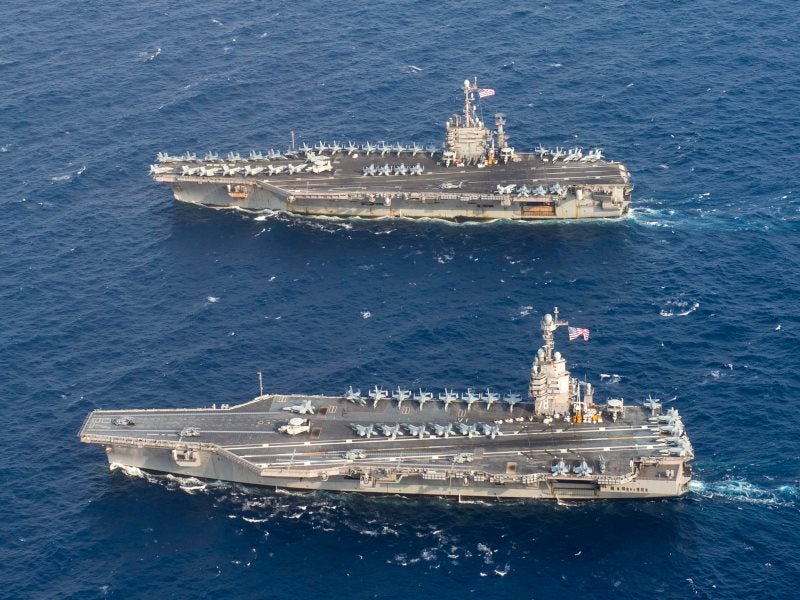
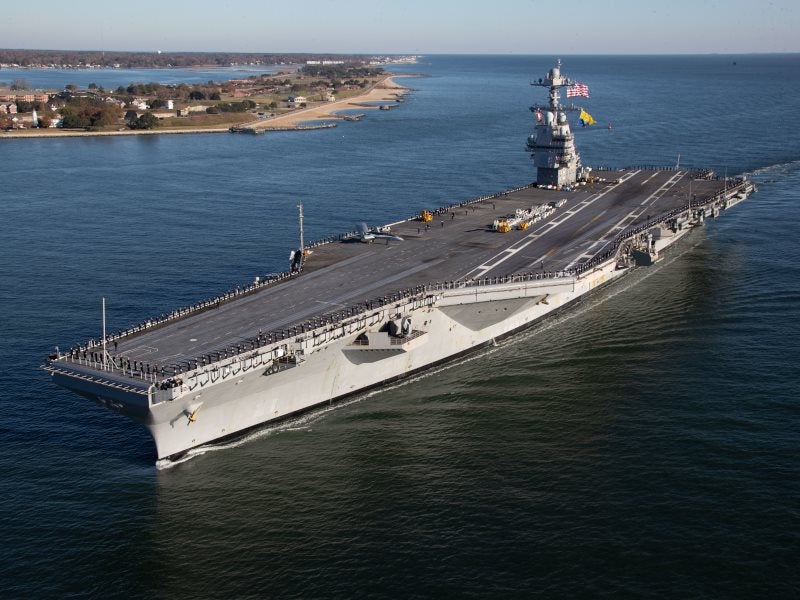
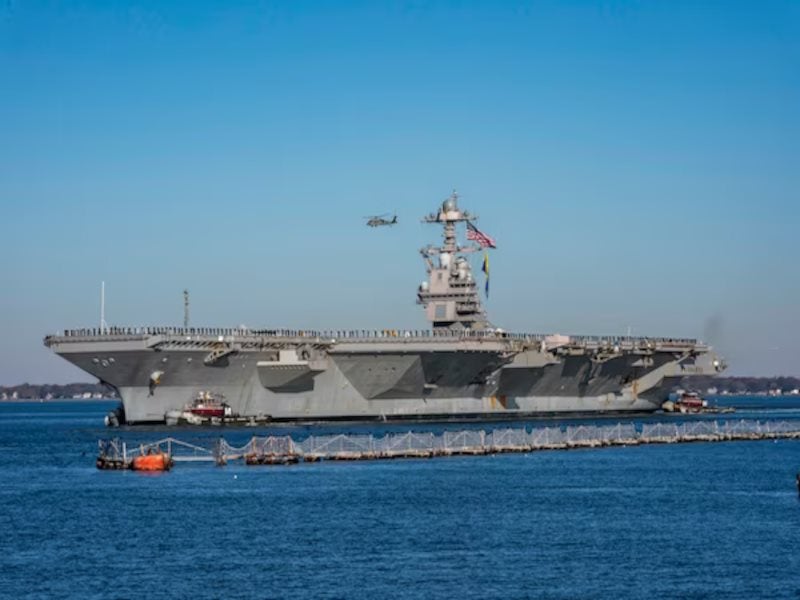


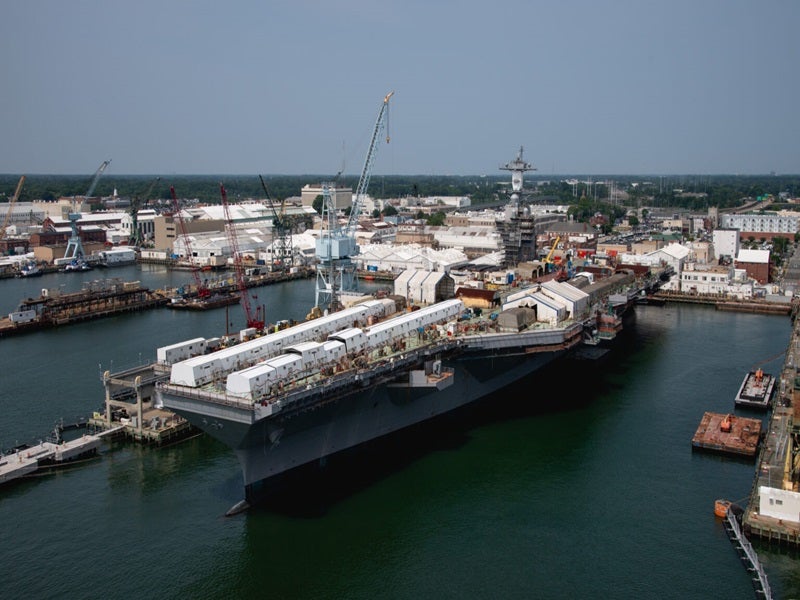
The Gerald R. Ford-class is a fleet of nuclear-powered aircraft carriers (CVNs) being developed by the Newport News Shipbuilding (NNS) division of Huntington Ingalls Industries (HII) for the US Navy under its CVN-21 Aircraft Carrier Program.
The first six ships in the Gerald R. Ford class are the USS Gerald R. Ford (CVN-78), USS John F. Kennedy (CVN-79), USS Enterprise (CVN-80), USS Doris Miller (CVN-81), William J. Clinton (CVN-82) and George W. Bush (CVN-83).
Recommended Buyers Guides

The USS Gerald R. Ford was delivered to the US Navy in May 2017 and commissioned in July 2017.
The ship replaced the USS Enterprise (CVN 65), which was decommissioned after more than five decades of active service in 2017.
Gerald R. Ford-class deployed for Operation Epic Fury
The Gerald R. Ford-class’ lead ship, the Gerald R. Ford, has been deployed in the Red Sea in support of Operation Epic Fury, launched by the US and Israel against Iran in February 2026.
A fire broke out on the vessel in March 2026, although it was not combat related. The vessel continues to operate at full capacity for the operation.
Gerald R. Ford-class aircraft carriers design details
The Gerald R. Ford-class carriers have a length of 333m, a beam of 40.8m and a flight deck width of 78m.
With a displacement of approximately 100,000t, the Gerald R. Ford-class is larger than its predecessor, the Nimitz-class, but accommodates between 500 and 900 fewer crew members.
The ships will feature 23 new or upgraded systems compared to the Nimitz-class carriers.
The reduction in manpower was a key performance parameter added to the original four outlined in 2000 in the operational requirements document for the CVN 21 programme.
It is estimated that the new carrier technologies will lead to a 30% reduction in maintenance requirements and a further crew workload reduction will be achieved through higher levels of automation.
Other main differences in operational performance compared with the Nimitz-class are increased sortie rates at 160 sorties a day (compared with 140 a day), a weight and stability allowance over the 50-year operational service life of the ship, and an increase of approximately 150% in electrical power generation and distribution to sustain the ship’s advanced technology systems.
Another key performance requirement is interoperability.
Gerald R. Ford class vessel development details
The first steel for the USS Gerald R. Ford was cut in August 2005, and the keel was laid in November 2009. The ship was launched and made its first voyage in November 2013, after being fitted with four 30t bronze propellers. Anchor testing was completed in June 2014, and electromagnetic aircraft launch system (EMALS) testing took place in May 2015. The ship entered service in July 2017.
Construction of the USS John F. Kennedy began in February 2011, and its keel was laid in July 2015. It was christened and launched in December 2019. The carrier completed builder’s sea trials in February 2026 and is scheduled to be delivered to the US Navy by March 2027.
The first steel for the USS Enterprise was cut in August 2017, and the keel was laid in August 2022. Scheduled for commissioning in July 2030, the vessel is being built using steel from CVN 65, which was decommissioned in April 2018. It is the ninth USS Enterprise and will replace the USS Dwight D Eisenhower, which is expected to be decommissioned in 2029.
The first steel for the USS Doris Miller was cut in August 2021. The keel is expected to be laid in 2026, with delivery scheduled for February 2032.
The William J. Clinton and George W. Bush carriers are scheduled for delivery in 2040 and 2043, respectively.
Gerald R. Ford-class aircraft carrier hull
The Gerald R. Ford-class carriers’ hull design is similar to that of the current Nimitz-class carriers, with the same number of decks. The island is smaller and positioned further towards the aft of the ship.
The island features a composite mast with planar array radars, a volume-search radar operating at S-band and a multifunction radar at X-band.
It also carries a stern-facing joint precision approach and landing system, which is based on the local area differential GPS rather than radar.
The aircraft carrier traditionally carries the flag officer and 70 staff of the carrier battle group. The flag bridge, which was previously accommodated on the carrier’s island, was relocated to a lower deck to reduce the size of the island.
The ship’s internal configuration and flight deck designs have changed significantly. The lower decks incorporate a flexible, rapidly reconfigurable layout, enabling various layouts and the installation of new equipment in command, planning and administration areas.
The requirement for a higher sortie rate of 160 sorties per day, with surges up to a maximum of 220 sorties per day during times of crisis and intense air warfare, led to design changes in the flight deck.
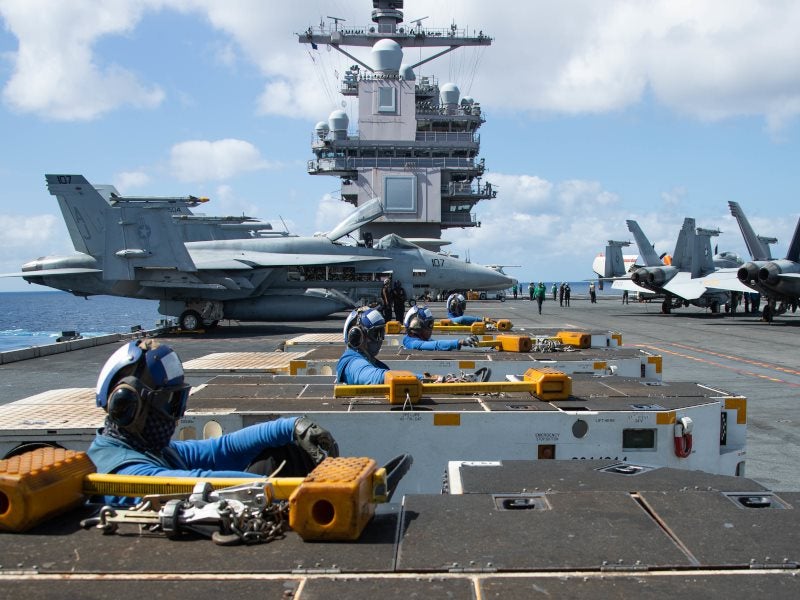
The flight deck features a relocated, smaller island and three deck-edge elevators instead of four. Deck extensions also increase the aircraft parking areas, and aircraft service stations are located near the 18 refuelling and rearming stops.
The requirement to build in a weight and stability allowance will accommodate the added weight of new systems that will be installed over the 50-year operational life of the ship.
The removal of one aircraft elevator unit and the reduction in the number of hangar bays from three to two contributed to a weight reduction of the vessels.
Sensors
In October 2008, Raytheon was contracted to supply a version of the dual-band radar (DBR) developed for the Zumwalt-class destroyer, for installation on the Gerald R. Ford. DBR combines X-band and S-band phased arrays.
Propulsion
Northrop Grumman developed an advanced nuclear propulsion system with two reactors, four shafts and a zonal electrical power distribution system for the carriers.
Gerald R. Ford-class aircraft carrier performance
The carrier can carry up to 90 aircraft, including the F-35 Joint Strike Fighter, F/A-18E/F Super Hornet, E-2D Advanced Hawkeye, EA-18G Growler electronic attack aircraft, MH-60R/S helicopters, as well as unmanned air and combat vehicles.
The aircraft carriers are equipped with General Atomics’ Systems Group’s (GA-EMS) EMALS, which uses a linear electromagnetic accelerator motor. The EMALS replaces the current C-13 steam catapults traditionally used on vessels to launch aircraft, expanding the aircraft launch envelope for future manned or unmanned aircraft.
EMALS technology offers the potential benefit of finer aircraft acceleration control, which leads to lower stress levels in the aircraft and pilots, provides a slower launch speed for unmanned air vehicles and allows a wider window of wind-over-deck speed required for the launch sequence.
The ships are also equipped with advanced arrestor gear (AAG). The electromagnetic motor applies control to the synthetic arrestor cable to reduce the maximum tension in the cable and decrease the peak load on the arrestor hook and the aircraft fuselage.
Weapons onboard Gerald R. Ford-class carriers
The Gerald R. Ford-class carriers can be armed with the Raytheon-evolved Sea Sparrow missile, which defends against high-speed, highly manoeuvrable anti-ship missiles.
The close-in weapon system is the rolling airframe missile from Raytheon and Ramsys.
Aircraft weapon loading
The flow of weapons to the aircraft stops on the flight deck was upgraded to accommodate the higher sortie rates.
The ship carries stores of missiles and cannon rounds for fighter aircraft, bombs and air-to-surface missiles for strike aircraft, and torpedoes and depth charges for anti-submarine warfare aircraft.
Weapons elevators transport the weapons systems from the magazines to the weapons handling and assembly areas on the 02-level deck (below the flight deck), and express weapons elevators are installed between the handling and assembly areas and the flight deck.
The US Navy outlined a requirement for a minimum increase of 150% in the power-generation capacity for the CVN 21 carrier compared with the Nimitz-class carriers.
The increased power capacity is required for the four electromagnetic aircraft launchers and for future systems such as directed energy weapons that may become feasible during the carrier’s 50-year lifespan.
Contractors involved
The US Department of Defense awarded NNS a $107.6m contract in July 2003 and a $1.39bn contract in May 2004. The department also provided $559m to prepare for the carrier construction and continue the design programme on the ship’s propulsion system.
A $5.1bn contract for the detailed design and construction of the USS Gerald R. Ford was awarded to NNS in September 2008.
NNS also won a contract to support further repair work on the lead ship. The contract covers execution planning for the repair and alteration requirements of the ship’s planned incremental availability.
Northrop Grumman was awarded a planning and design contract for the second carrier, the USS John F. Kennedy, in November 2006.
NNS was awarded a $407m contract extension for the preparation work on the USS John F. Kennedy ship in March 2013 and a $1.29bn extension in March 2014. It also received a $3.35bn contract for the ship’s detailed design and construction in June 2015.
In May 2016, NNS was awarded a $152m contract for the advanced planning, engineering, design and procurement of long-lead-time material for the third ship of the class, the USS Enterprise.
A $25.5m modification contract was awarded for advanced fabrication of the aircraft in February 2017.
NNS received a $15.2bn contract modification in January 2019 for the detailed design and construction of the USS Enterprise and USS Doris Miller.
In June 2023, GA-EMS received a contract modification from the Naval Air Systems Command to supply EMALS and AAG for the USS Doris Miller.
HII secured a $471.9m contract to provide engineering support for Gerald R. Ford-class aircraft carriers and Nimitz-class carriers.
Suppliers involved are Fairbanks Morse, the Philadelphia Gear division of Timken, QinetiQ, Federal Equipment Company and Oldenburg Lakeshore.
