
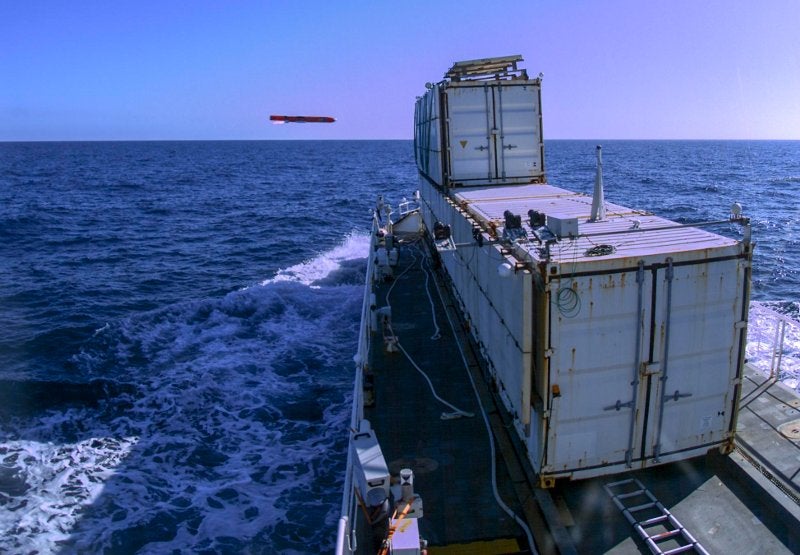
MBDA has successfully completed the first qualification firing of its Sea Venom / Anti-Navire Léger (ANL) anti-ship missile at the Île du Levant test range in south-east France.
The 120kg new generation medium-range missile has been designed to offer an enhanced maritime strike capability under the Anglo-French co-operation programme.
Go deeper with GlobalData


Discover B2B Marketing That Performs
Combine business intelligence and editorial excellence to reach engaged professionals across 36 leading media platforms.
It will replace several existing and ageing anti-ship missile systems, such as the UK-developed Sea Skua missile and the French-developed AS15TT missile.
The missile will serve as the principal anti-ship weapon for the UK’s AW159 Wildcat, while France’s Marine Nationale has plans to integrate it on the future Guépard Light Joint Helicopter (HIL – Hélicoptère Interarmées Léger).
The qualification test firing of Sea Venom / ANL was carried out from a Dauphin helicopter.
During testing, the missile flew at a very low sea-skimming altitude and transmitted images to aircrew from its infrared seeker via the data link. This allowed the operator to manually select a precise aim point.

US Tariffs are shifting - will you react or anticipate?
Don’t let policy changes catch you off guard. Stay proactive with real-time data and expert analysis.
By GlobalDataSea Venom / ANL successfully destroyed the target ‘with a very high degree of accuracy’.
MBDA CEO Éric Béranger said: “Sea Venom/ANL is the first Anglo-French co-operation programme to take full advantage of our centres of excellence, created following an Inter-Governmental Agreement ratified by both nations’ Parliaments in 2016.
“MBDA is putting full effort into the successful implementation of the Sea Venom/ANL programme, recognising it should exemplify the benefits of the close co-operation UK and France are sharing in defence, enhancing both nation’s sovereign capabilities in armaments while reducing costs.”
Sea Venom/ANL already demonstrated its lock-on after launch (LOAL) and lock-on before launch (LOBL) capabilities during its previous firing trials.
The 2.5m-long missile features 30kg anti-ship warhead and can travel at high subsonic speed.
The missile will enable the helicopters to address a wide range of targets from small craft to larger warships at sea or in port.
MBDA was awarded the development contract for the Sea Venom / ANL missile in March 2014.



