
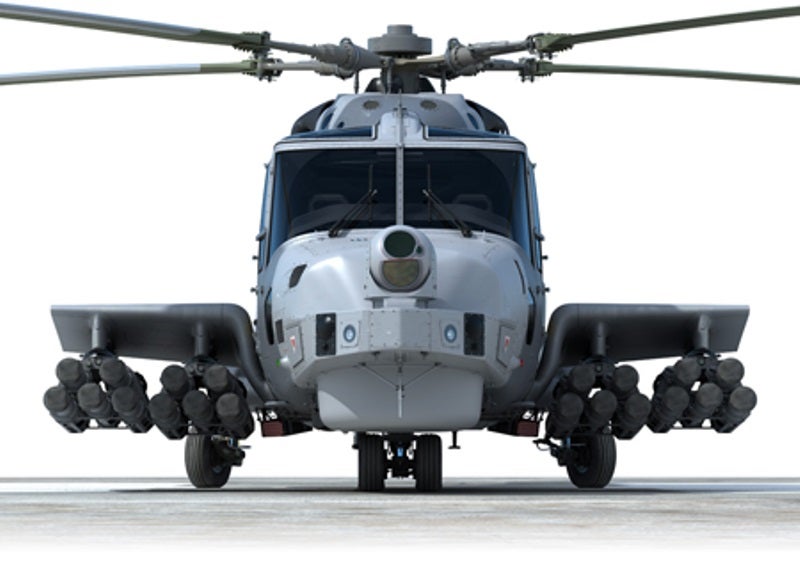
Thales has performed firing trials for the Future Anti Surface Guided Weapon (Light) (FASGW[L]) programme for the British Royal Navy.
Conducted at Royal Artillery Air Defence Range at Manorbier in Pembrokeshire, the trials are part of the FASGW(L) programme’s integration testing phase.

Discover B2B Marketing That Performs
Combine business intelligence and editorial excellence to reach engaged professionals across 36 leading media platforms.
The programme includes testing of all parts of the FASGW(L) weapon system, including Thales’ lightweight multirole missile (LMM), the launcher system and all key equipment of the Royal Navy’s Agusta Westland AW159 Wildcat helicopter.
In June 2014, Thales won a contract to develop, qualify and integrate the FASGW(L) system for the Navy’s Wildcat helicopter.
The system consists of a five-barrel launcher and a laser guidance system.
Set to enter service in 2020, LMM is a precision strike missile capable of being fired from a variety of land, sea and airborne tactical platforms.

US Tariffs are shifting - will you react or anticipate?
Don’t let policy changes catch you off guard. Stay proactive with real-time data and expert analysis.
By GlobalDataThe missile will be called Martlet in the Royal Navy. It is designed to defeat mobile maritime threats such as small ships and inshore attack craft.
LMM will offer improved protection for Royal Navy personnel and important sea assets, such as the Queen Elizabeth Carrier.
During trials, Thales fired six LMMs at a small boat target at sea at a distance of 4.5km.
The missiles feature telemetry software to facilitate collection of test data.
Information will be used to analyse the performance of the Thales-designed launcher, the guidance system and missile.
In a statement, Thales said: “The FASGW(L) system accurately guided all missiles to the targets and provided extensive data on the excellent performance of all elements of the ground set-up and inflight performance of the missile.
“The successful achievement of the ground firings is a major milestone and key to progressing to future testing including air firing trials later in 2019 and culminating in qualification and verification in 2020.”
The Royal Navy is also fielding Sea Venom/ANL helicopter-launched anti-ship missile to address its FASGW(H) requirements.
MBDA is delivering the Sea Venom/ANL missile under a contract jointly awarded by the UK and France.


