
Since its inception, the UK Royal Navy has always played a central role in British foreign policy and national security – though the precise nature of the tasks it has been asked to perform in pursuit of these goals has seen some dramatic changes over the intervening years.



Inevitably in today's fast-moving and increasingly uncertain world, both the nature of the fleet and the resources required to accommodate these shifts in military and political thinking demand continual re-evaluation.
Such periodic reviews are a necessary part of the defence policy cycle and facilitate the kind of evolution necessary to meet new challenges as they emerge, while also enabling the modern navy to meet the additional requirements of cost-effectiveness demanded of it.
The MARS project
This philosophy is particularly reflected in the military afloat reach and sustainability (MARS) project, which will see the replacement of many of the Royal Fleet Auxiliary (RFA) aging existing fleet, scheduled for progressive retirement over the next few years.
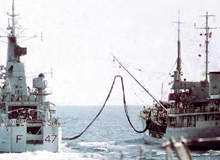
Aimed to ensure the Royal Navy's capability to operate away from home waters for extended periods of time, the initial focus of the project has been on the replenishment at sea (RAS) of 'bulk consumables' – ammunition, fuel, oil, lubricants, potable water and food.
Although the precise structure of the project itself has been altered and refined over time, the fundamental Royal Navy 'force projection' role requires MARS to be able to fulfil three central tasks. Bulk consumables need to be supplied to combatant and auxiliary vessels, joint sea-based logistics support provided to land forces inland of the beachhead and forward aviation support offered to naval rotary wing operations.
The MARS project comprises three distinct elements, the fleet tanker (FT), fleet solid support (FSS) and joint sea-based logistic (JSBL) vessels, with each class to be procured incrementally – the first round concentrating on the provision of double-hulled FT ships.
The principal driver on this has been the need to meet international regulations on maritime pollution, including an amendment to MARPOL (the international convention for the prevention of pollution from ships) and pollution regulations from the International Maritime Organisation (IMO) and the EU.
The predominantly single hulled vessels of the current RFA fleet will be non-compliant and though government-owned vessels can claim a waiver, MoD policy is to abide by such maritime acts wherever practicable. The FT requirement is currently for up to six ships; in order to keep a degree of flexibility within the overall programme, the FSS and JSBL are not being committed at present.
Heavyweight challenge
The procurement of these replacement ships is in part predicated on the need to support the new CVF aircraft carriers – HMS Queen Elizabeth and HMS Prince Of Wales – the Royal Navy's largest and most powerful surface warships ever.
Expressly intended to be a major element in improving the UK expeditionary capabilities, supplying them underway will make unprecedented demands on RAS capability. Transfer systems in these new vessels will need to deal with appreciably heavier loads than presently handled, transfer them at faster rates, at a greater ship-to-ship separation – and potentially in heavy seas.
This will impose significant conditions on both system design and the layout of the new ships' holds and meeting these requirements will obviously mandate a fundamentally different internal layout and organisation.
Although during peace time, transferring most solids and ammunition by helicopter – known as VERTREP – tends to be the norm, there are obvious problems with this approach. While handling the load tonnages for CVFs might conceivably be possible by air, the availability of suitable aircraft cannot always be guaranteed, and certainly not during conflict.
Clearly traditional RAS must be available as the first option – albeit strengthened and adapted to the new circumstances – and this will generate its own strictures for FSS vessel design.
Commercial construction
In line with modern value-for-money constraints, commercial and manufacturing issues feature highly in the procurement mix, with affordability and construction times forming major considerations. The new vessels are expected to be built using commercial standards and design practice, which will be instrumental in keeping the overall cost down, while allowing construction at any suitable shipyard.
Unsurprisingly, as a result many of the concepts appropriate to the MARS project draw on established design features – including the likes of the Rolls-Royce NVC replenishment ship and the Aegir family of naval task force support ships from BMT Defence Services.
While the eventual specification of both the FSS and JSBL ships remains to be decided, in May 2008, the MoD took a major step towards the delivery of the FT element of the project, with the announcement of the selection of four companies / consortia to compete to design and build the new ships.
The four – Fincantieri, Hyundai, Navantia and BAE Systems with BMT DSL and DSME – were chosen, according to Baroness Taylor, Minister for Defence Equipment and Support, for their capability and capacity to deliver within the timeframe required.
Throughout the development of the project, there has been considerable debate over the procurement approach to be adopted.
British shipyards – increasingly specialised for the construction of sophisticated warships and with their capacity already committed to the new type 45 destroyer and the CVF – are unlikely to be in a position to compete effectively for the MARS ships. The procurement route chosen for the new tankers was open competition, via the Official Journal for the European Union, with none of the selected bidders intimating that the FT vessels would be built in the UK.
Despite the apparent benefits of building the FT hulls abroad, if the British government were to classify some or all of the future MARS vessels as military – rather than auxiliary – then construction tenders could be restricted to UK shipyards only, on the grounds of national security. BAE Systems, amongst others, has argued that there is a very strong case to do this, especially for the more technologically advanced of the new ships.
In the 2006 'future navy vision', Admiral Sir Jonathon Band, the First Sea Lord and Chief of Naval Staff, makes the point that "Britain is pre-eminently a maritime nation whose people will continue to rely on the unhindered use of the sea for their security, prosperity and well-being."
Given the UK's interests worldwide, national security demands and global commitment to military and policing actions, expeditionary military forces remain as relevant for the future as at any time in the country's history. If, as Napoleon famously observed, an army marches on its stomach, then surely a navy must sail on its supplies; effective replenishment at sea stands as the guarantee of the Royal Navy's continued ability to play its role on the international stage.


